


Spotting a puma in its natural habitat is one of Patagonia’s most thrilling experiences, combining adventure, discovery, and respect for nature. In this new blog, we’ll introduce you to one of the most iconic individuals of the local puma population living at the southern tip of the continent: Dark, an alpha male who has ruled his territory for more than a decade.
The Alpha Male’s Territory
Encountering a puma in the wild is a privilege—sometimes a matter of sheer luck, other times the result of patience, knowledge of the land, and above all, respect for the animal. Dark rules the transition zone between Torres del Paine National Park and Estancia Laguna Amarga, stretching from west to east. This sector offers everything a dominant puma needs: abundant prey, strategic cover, and breeding grounds.
Though estimated to be 12 years old, Dark still hunts with ease. His strength and experience allow him to move with complete confidence when facing other cats. He knows every corner of his territory—every shrub and natural barrier—and uses them to his advantage when stalking prey. Like any mature male, he marks his domain with scrapes in the ground, urine, and visual signals that send a clear message to rivals: I’m in charge here.
This dominance not only ensures him access to prey but also to females during the breeding season. Dark is likely the oldest individual in the area, a true veteran of the land—something rare in the wild, where competition and injuries often shorten lifespans.
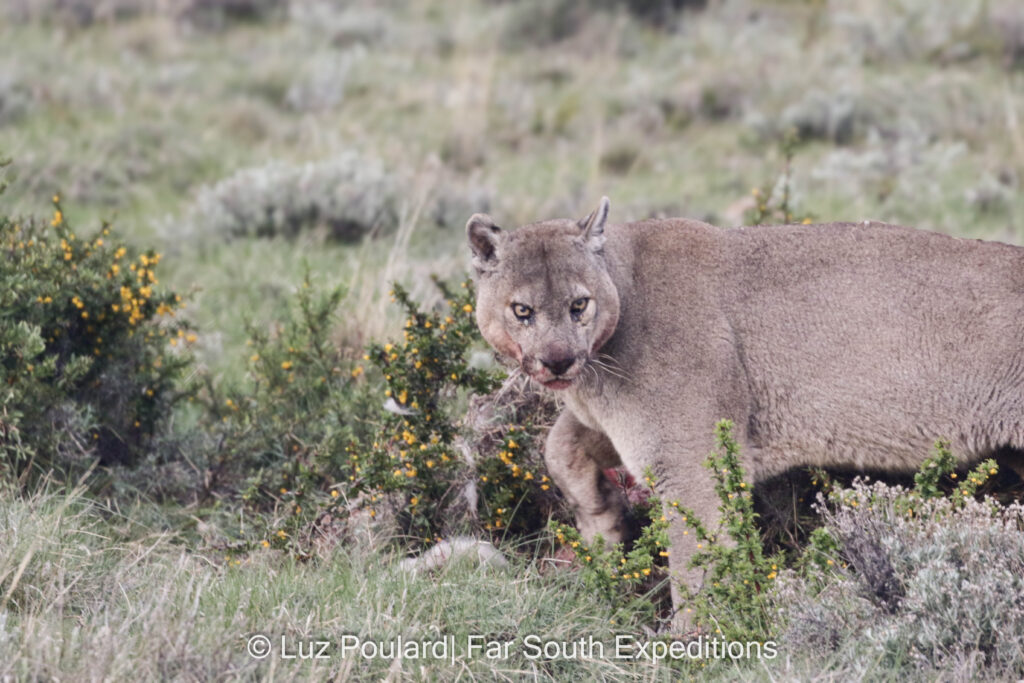
Unlike many other pumas, Dark shows a peculiar behavior around humans. He is cautious and alert to people’s presence, but one might even call him selectively sociable. “It’s as if he can tell who respects his space and who doesn’t,” says David Couve, naturalist guide and puma tracker on our expeditions. For this reason, there are times when Dark chooses to reveal himself to certain groups, while on other occasions he stays completely invisible. This unusual trait could be the result of past experiences with humans, teaching him to carefully choose when and with whom to interact—a behavior not surprising given the long and often conflicted history between pumas and humans.
As a proper alpha, Dark favors high vantage points where he can keep watch over both prey and rivals. The abundance of food and females in his range has allowed him to remain here, patrolling short distances to maintain control.
Today, Dark finds himself at a key moment in his reign. The scars across his body tell the story of past battles, and although other males—such as Taurus and Virgo—have tried to challenge him, his skill and strategy still keep him ahead. Winter, the mating season, heightens reproductive pressure and competition, yet Dark stands firm.
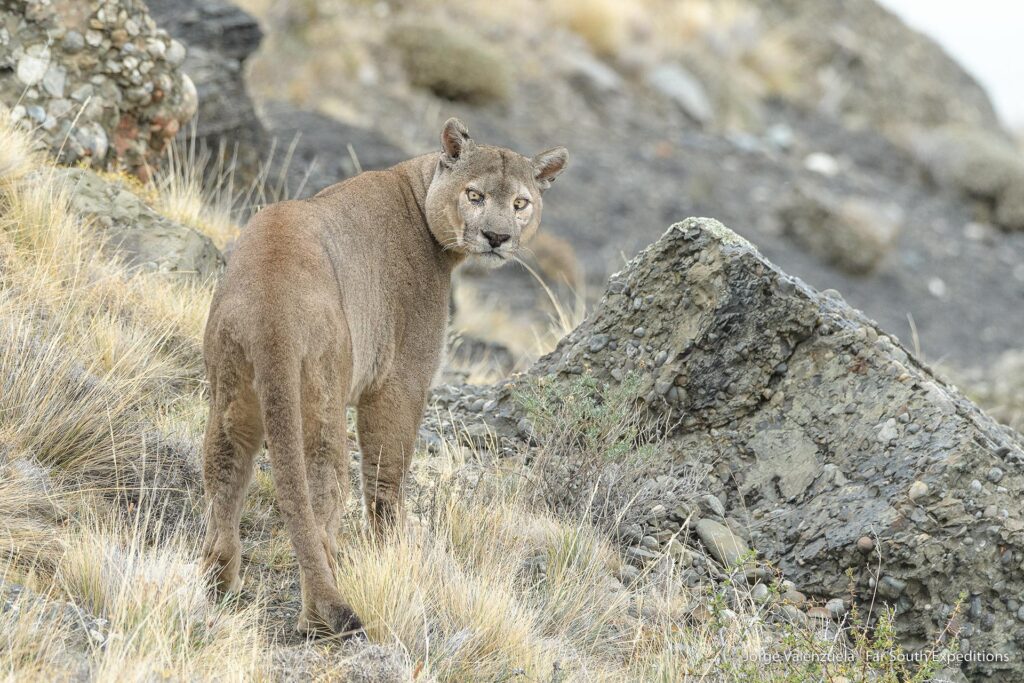
One of his most impressive talents is his camouflage. He can be just a few meters away, hidden behind a bush, and remain completely unnoticed until he decides to move. Often his presence is only detected through indirect signs, making the chance to actually see him an extraordinary privilege.
A Keystone Predator in the Ecosystem
The puma is the largest cat in Patagonia and a true apex predator, meaning it regulates herbivore populations such as guanacos. This ecological role prevents overgrazing and helps maintain vegetation balance, indirectly benefiting countless other species.
In Patagonia, their presence also shapes the distribution of foxes, condors, and other scavengers that feed on their kills—such as the Andean condor (Vultur gryphus), South American gray fox (Lycalopex griseus), culpeo fox (L. culpaeus), austral blackbird (Curaeus curaeus), black-chested buzzard-eagle (Geranoaetus melanoleucus), and even the hairy armadillo (Chaetophractus villosus).
Even invertebrates like carrion beetles thrive on the remains of their kills, using them as both food and shelter. This is why the puma is considered a keystone species, essential for maintaining the health and balance of Patagonian ecosystems.
Patience as the Best Ally
Searching for pumas isn’t about chasing them down—it’s about learning to read the landscape. Pumas are stealthy and observant, knowing every stone, bush, and trail in their range, and moving through it unnoticed. That’s why patience is the greatest tool for those hoping to encounter them.
Dawn and dusk are their most active hours. During these times, they patrol their territories, hunt, or move between resting and hunting areas. Remaining still, silent, and alert is part of the experience.
Our guides and trackers are trained to interpret the signs: fresh tracks in the soil, prey remains hidden under vegetation, scrape marks, areas carefully trodden by the cat, the circling of birds over a potential carcass, or the nervous alarm calls of a guanaco.
Live the Experience
At Far South Expeditions, we take you deep into puma territory at Estancia Laguna Amarga, always with a responsible wildlife-viewing approach and guided by expert locals.
If you want to feel the thrill of following tracks, reading the landscape, and—if luck is on your side—coming face to face with the great alpha of Patagonia, this is the place to do it.
Explore our Puma Tracking Trips section and discover more real-life stories of these cats, like Dark and Petaca, on our blog. And if you’d like to learn about ongoing conservation efforts, follow The Fang Project.



Leave a Reply
Your email is safe with us.