

Among the great diversity of birds found throughout Chile, there is a group that always sparks curiosity and admiration: birds of prey. In this first part of our series, we invite you to discover the nocturnal birds of prey, a group of specialized predators that play a key role in regulating populations of small mammals, birds, and insects, directly contributing to the balance of ecosystems.
What Are Birds of Prey?
The term “raptor” comes from the Latin rapere, meaning “to seize” or “to take by force,” accurately describing how these birds capture their prey. Birds of prey are exceptional hunters, and they all share three main characteristics:
– Strong, hooked beak, ideal for tearing flesh.
– Powerful, sharp talons, with toes designed to firmly grasp prey.
– Exceptional vision and hearing, making them highly efficient hunters.
Birds of prey include the orders Falconiformes and Accipitriformes (diurnal raptors) and the order Strigiformes (nocturnal raptors). While they share some morphological and behavioral traits, Strigiformes have different ancestors and unique adaptations that make them nighttime specialists.
Nocturnal Birds of Prey: Order Strigiformes
Strigiformes — owls and related species — are raptors specialized in crepuscular and nocturnal hunting. Although some species may be active during the day, most of their activity occurs in low-light conditions.
Their most notable features include:
Large, forward-facing eyes: occupying much of the head with circular pupils capable of extreme dilation, allowing them to capture maximum light in darkness.
Binocular vision: the frontal eye placement allows them to judge depth and estimate distances accurately. With very limited lateral vision, they move their heads to scan from different angles.
Head rotation up to 270°: compensates for immobile eyes, increasing their field of view.
Asymmetrical hearing and directional listening: uneven ear placement, combined with head movements, enables precise triangulation of sounds to locate prey accurately.
Facial disc: the characteristic round face, often heart-shaped, acts like a parabolic antenna that channels sound waves to the ears.
Silent flight plumage: specialized feathers reduce noise, enhancing hunting efficiency.
Although their night vision is exceptional, studies have shown that hearing is the most important sense for capturing prey. The combination of sight and sound makes them highly specialized nocturnal predators.
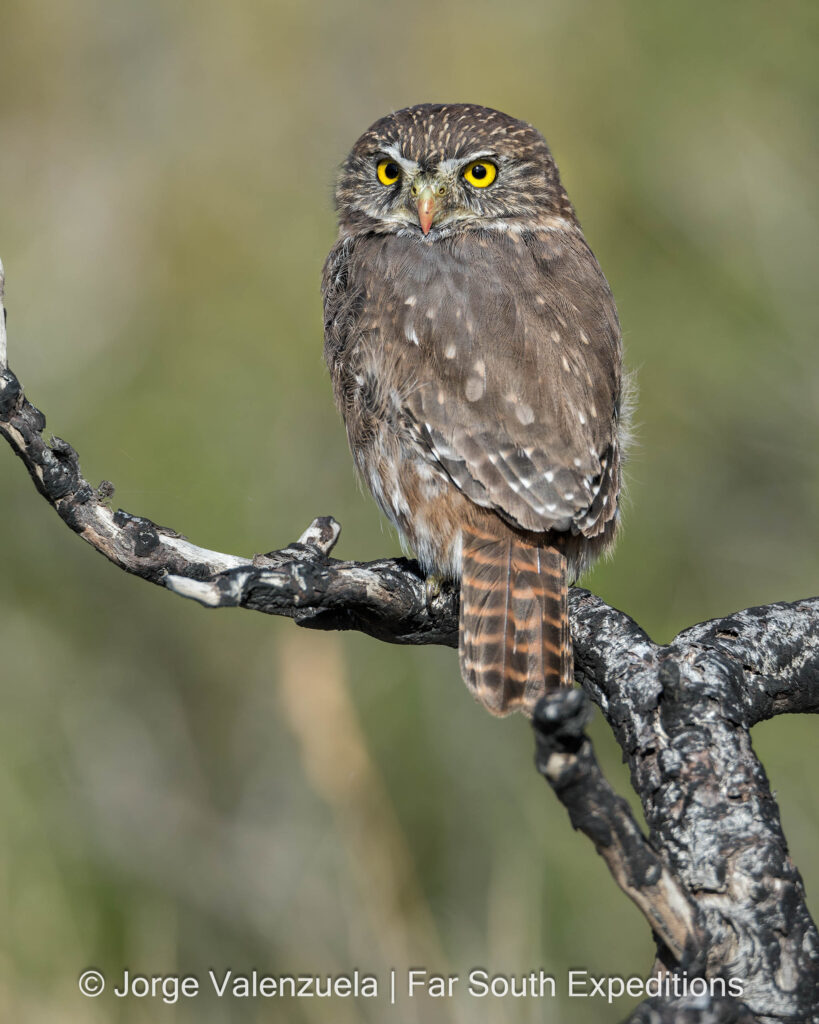
Species in Chile
Seven species of nocturnal raptors inhabit Chile. One belongs to the family Tytonidae: the Barn Owl (Tyto alba). Six belong to the family Strigidae: the Magellanic Horned Owl (Bubo virginianus), the Rufous-legged Owl (Strix rufipes), the Peruvian Pygmy Owl (Glaucidium peruanum), the Austral Pygmy Owl (Glaucidium nana), the Burrowing Owl (Athene cunicularia), and the Short-eared Owl (Asio flammeus).
Some species inhabit the temperate forests of southern Chile, while others are found in arid northern environments or in open valleys and plains. Certain species — such as the Barn Owl and the Burrowing Owl — can also be found in rural and urban areas, where they play a vital role in controlling rodent populations.
A Visual Look
To conclude this overview of Chile’s nocturnal birds of prey, we invite you to explore a gallery of photographs showcasing the beauty and unique characteristics of these fascinating species.

In Chile, the Burrowing Owl (Athene cunicularia) ranges from the far north down to the Reloncaví Sound. It is also found on Santa María Island in the Biobío Region, although it is absent from Chiloé. On the Argentine side, its distribution in Patagonia extends as far as Puerto Deseado. In the Magallanes Region, there are few records, including sightings in Pali Aike National Park and at Punta Dungeness.
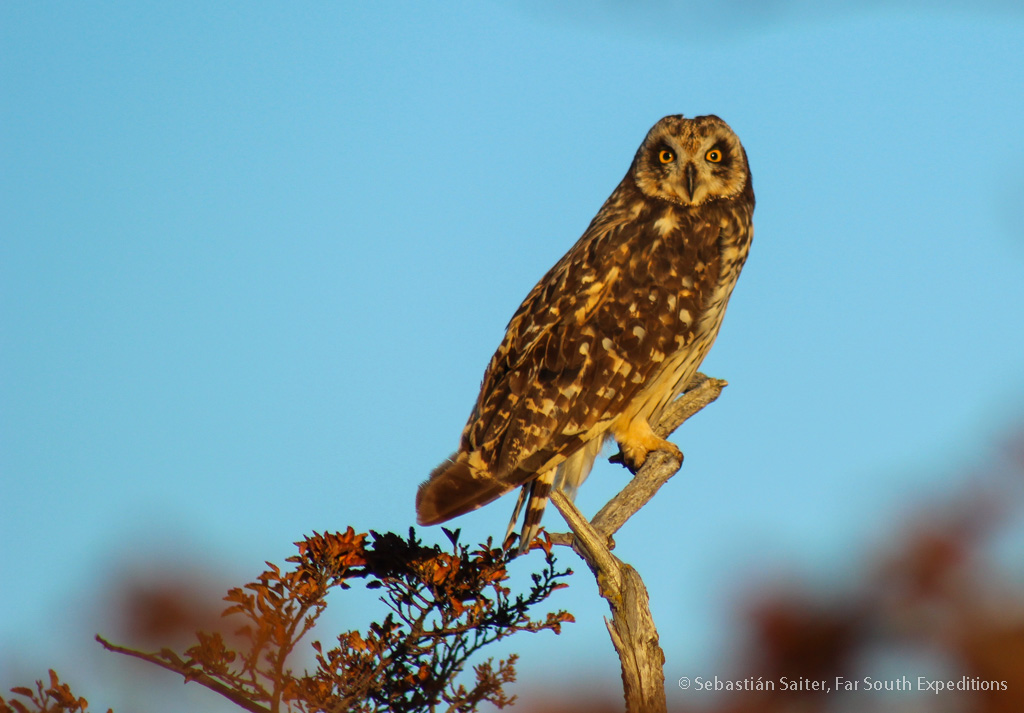
In Chile, the Short-eared Owl (Asio flammeus) is mainly found from the Coquimbo Region down to Tierra del Fuego. There are also isolated records at the mouth of the Lluta River and in the Arica and Parinacota Region. Additionally, it is present in the Juan Fernández Archipelago, specifically on Robinson Crusoe and Santa Clara Islands.
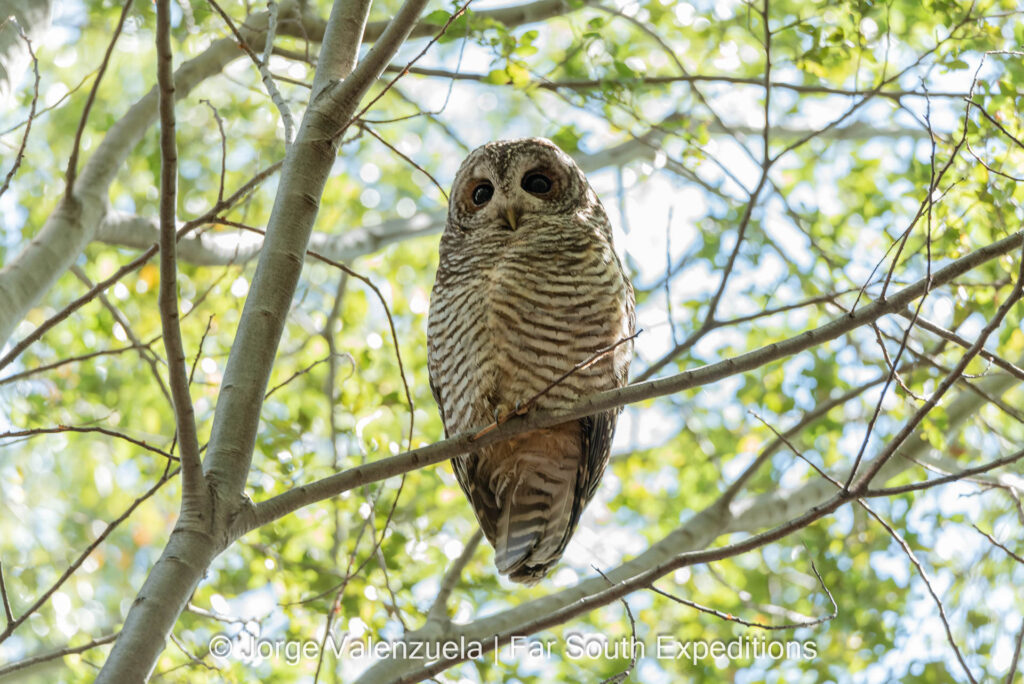
The Rufous-legged Owl (Strix rufipes), also known as the Concón, is distributed in Chile from Cerro Santa Inés in the Coquimbo Region down to Puerto Williams in the Magallanes Region. Its main habitat consists of mature forests, whether sclerophyllous, laurel (laurifolia), or Nothofagus forests, although it can also be found in areas of monoculture plantations.

The Magellanic Horned Owl (Bubo magellanicus), also known as the Tucuquere, is found throughout Chile, with its southernmost records in Puerto Williams. Although it shows remarkable adaptability, it typically prefers wooded highlands with rocky outcrops. Its range of habitats is broad and diverse, including the high Andes, dry coastal scrublands, temperate forests —both dry and cold—, the Patagonian steppe, as well as coastal and insular environments.
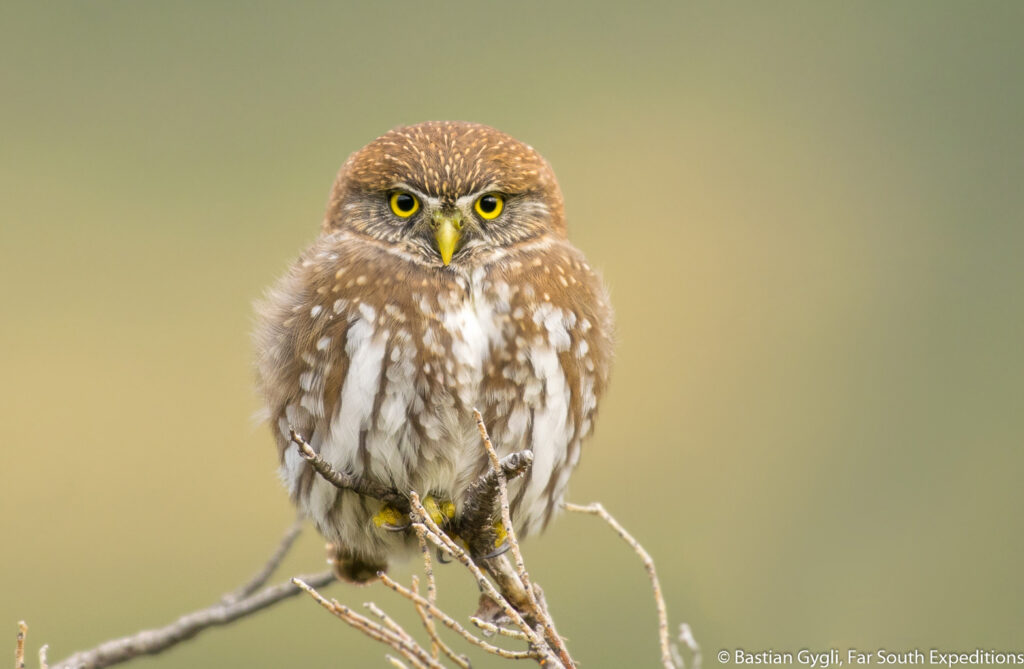
The Austral Pygmy Owl (Glaucidium nana) is a common species in the temperate forests of southern Argentina and Chile. Its distribution extends from the Atacama Region in northern Chile to the southernmost reaches of the continent, including the Beagle Channel and Isla de los Estados.






2 Comments
Leave your reply.