

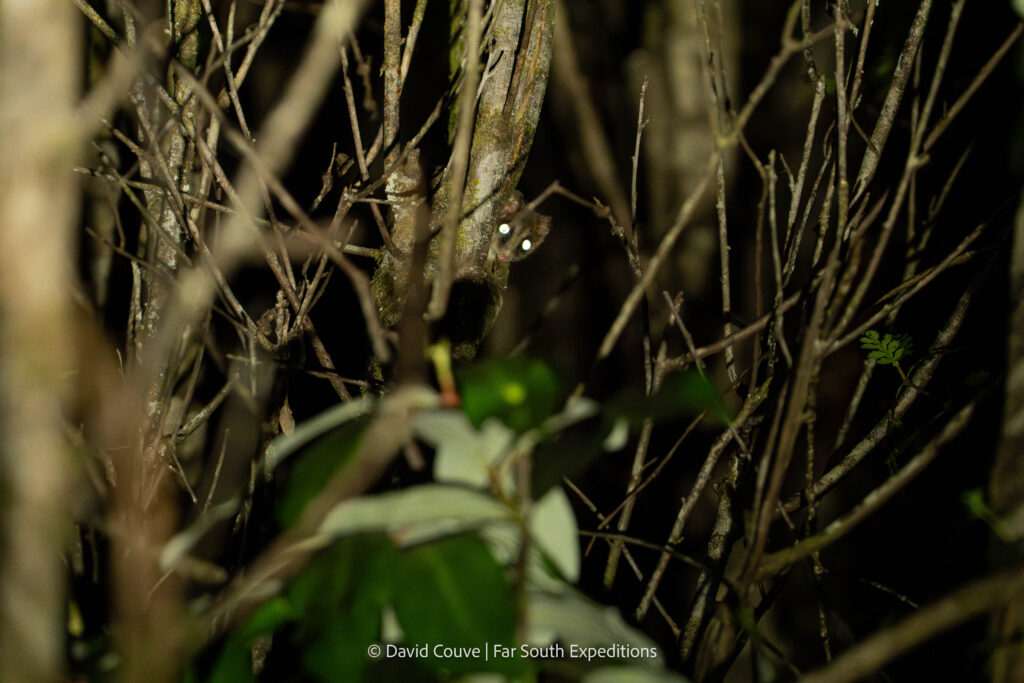
On several of our expeditions through southern Chile, we’ve been fortunate to spot a small and elusive mammal that inhabits the rainy Valdivian forest: the Monito del Monte. Often described as a living fossil, this unique marsupial is the only surviving member of an ancient lineage that dates back millions of years.
An Endemic Marsupial of the RainForest
The Monito del Monte (Dromiciops gliroides) is a small marsupial endemic to the temperate rainforests of southern Chile and Argentina, especially in areas dominated by Valdivian forest, where Nothofagus species and evergreen bamboos are abundant. In Chile, four marsupial species have been identified, and the Monito del Monte stands out for its remarkable evolutionary history.
With a body length of 8 to 13 centimeters and a tail almost as long (9 to 12 cm), this tiny creature is the only living representative of the order Microbiotheria, whose other members are now extinct. Spotting this elusive forest dweller during our expeditions is undoubtedly a true privilege.

Monito del Monte: A Witness to Evolutionary History
The Monito del Monte stands out not only as a rare and endemic species of South America, but also as an important figure in evolutionary science. Studies suggest that this small species could help us better understand the evolutionary history of marsupials worldwide. In particular, it is believed to be an “evolutionary link” between South American and Australian marsupials, as it shares anatomical traits with both groups.
This points to a common ancestor, and suggests that marsupials may have dispersed from South America to Australia in ancient times, when the continents were still connected as part of the supercontinent Gondwana.
Ready to go in search of the Monito del Monte?
Take a look at our itineraries!
Nocturnal, Agile, and Hibernating
The Monito del Monte is a nocturnal species, active at night thanks to its well-developed sense of smell and vision.
It mainly lives in the upper layers of the forest, moving through branches, dense bamboo (quila), and standing dead trees. It is an expert climber, a skill made possible in part by its prehensile tail and opposable thumbs, which allow it to move with great agility.
In spring, the female gives birth to a single litter per year, usually consisting of two to four young.
One of the most remarkable traits of this species is that it is the only mammal in Chile known to hibernate. During the coldest and rainiest months, when food is scarce, the Monito del Monte enters a state of prolonged torpor to conserve energy.
In addition to all this, it plays a key ecological role: it is an important seed disperser, helping regenerate native forests.
Monito del Monte: A Marsupial Mammal
Marsupials are group of mammals that belong to the infraclass Metatheria, and they make up around 6% of all living mammal species today.
Like all mammals, marsupials have fur and nurse their young with milk. However, what truly sets them apart is the way they care for their babies:the young are born very small and underdeveloped, and they complete much of their growth outside the mother’s womb.
Manu marsupial species have a “pouch” on their abdomen, called marsupium, where the young take refuge and remain attached to the mother’s teats as they continue to develop. While marsupials do have a placenta — like a placental mammals — it is much simpler and only functions for a short time.



Leave a Reply
Your email is safe with us.