

With their unmistakable sharp calls and energetic flight, southern lapwings are once again announcing their arrival in southern Patagonia. These birds inhabit grasslands, wetlands, agricultural fields, parks, and even urban areas, where they become especially noticeable during spring and summer. Their return coincides with the lengthening of days and increased daylight, which signals the onset of the breeding season for many species in the region.
Watchful Guardians of the Land
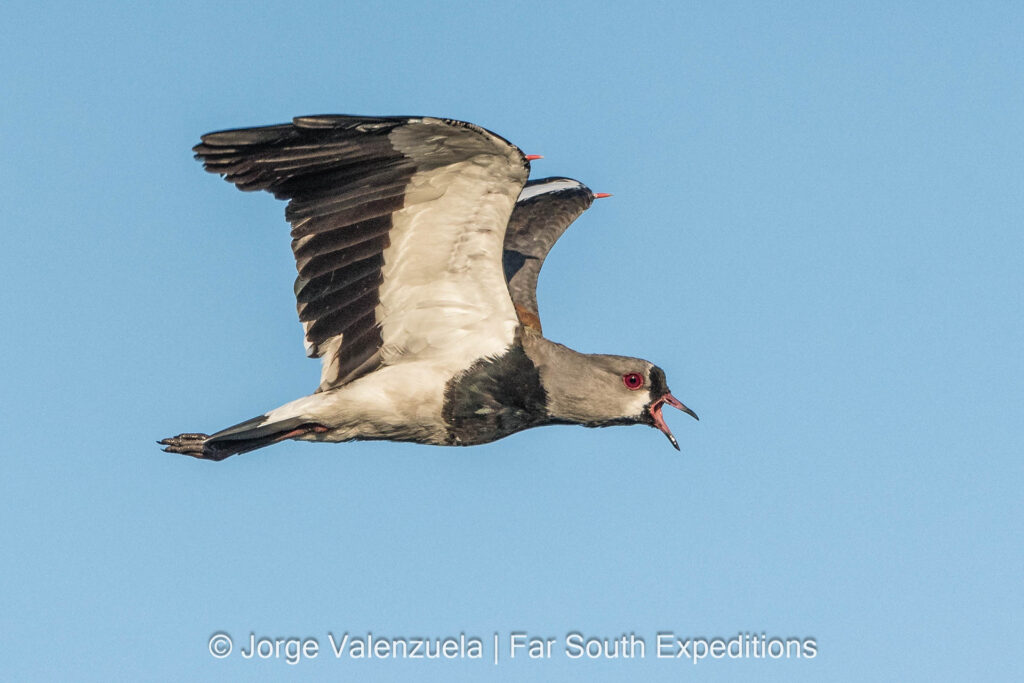
The southern lapwing (Vanellus chilensis) is an attentive and territorial bird. Its plumage combines shades of gray, black, and white, featuring a distinctive black band across the face extending to the chest, a white belly, iridescent wing coverts, a wispy black crest, and a striking reddish iris.
They walk confidently on the ground, but at the slightest sign of danger, they take flight while emitting their characteristic call: “tero – tero – tero – tero.” This call serves multiple purposes: signaling threats, performing display flights, or as part of courtship behavior.

Migration and Seasonal Cycles
Although they can be observed at different times of the year, lapwings in Magallanes typically migrate north during winter in search of warmer temperatures and more abundant food. They return with the arrival of spring, and by early autumn, they head back to milder latitudes. This migratory pattern makes the southern lapwing a true biological indicator of seasonal changes in the far south. Their presence is especially noticeable during the breeding season.
Their reproductive activity spans from April to January, covering winter, spring, and summer months.
A Remarkably Adaptable Species
One striking feature of southern lapwings is their adaptability. Despite urban expansion and increased human noise, they have found ways to thrive in human-dominated areas, expanding into agricultural and peri-urban spaces and consequently increasing their overall distribution.
Nesting in Grasslands
The lapwing’s reproductive strategy is fascinating. Unlike other birds that nest in trees or shrubs, they lay their eggs directly on the ground, among grass or low vegetation. Their eggs, brownish-green with dark speckles, blend perfectly with the environment, reducing the chances of being detected. However, they remain vulnerable to predators such as foxes, dogs, and birds of prey, as well as accidental human disturbances, as people sometimes unknowingly step on the eggs.
For this reason, parents are extremely vigilant and protective during this period: their low flights and constant calls distract potential intruders and give their chicks time to remain hidden.

A Call of the Southern Landscape
Beyond their striking appearance and behavior, lapwings are an integral part of the distinctive soundscape of southern Patagonia. Their constant calls resonate across wetlands, fields, and towns, reminding us of the rich natural life that coexists with human activities. Their return not only signals the arrival of spring but also invites us to pause and listen as nature renews its cycle at the southern edge of the continent.
Did you know…?
Southern lapwings have shoulder spurs, small but sharp projections located at the wing joints. These natural “weapons” help them defend against predators. Coupled with their vocalizations, these spurs allow lapwings to ward off intruders and protect their nests and chicks, showcasing their territorial and vigilant nature.



Leave a Reply
Your email is safe with us.